Showing posts with label French wine. Show all posts

Friday, September 6, 2013

Is Sager & Wilde set to be London's hippest wine bar?


Given the high profile casualties (Artisan & Vine and Green & Blue) that have befallen the London natural wine scene over the past couple of years it's not surprising the city's newest wine bar, Sager & Wilde, doesn't use the N-word. But it's a place in which any natural wine lover would feel at home.

The bar, which started as a pop-up last year, is run by husband and wife team Michael and Charlotte Sager-Wilde with the aim of giving customers a chance to drink top-end, often hard-to-find wines at affordable prices.

They have impressive CVs - Michael was previously the bar manager at Milk & Honey and wine director at Quo Vadis before moving to California to run RN74 while Charlotte has worked for Jamie Oliver, Terence Conran, Sketch, Milk & Honey, The East Room and Hawksmoor. 


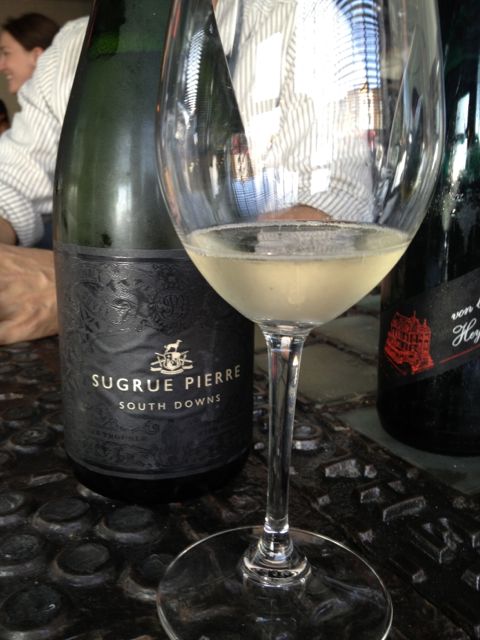
The basic idea is that to have a constantly changing selection of wines by the glass - "the best we can currently lay our hands on." I tried a selection including a rich flavoursome (am I really saying this of prosecco?) Zucchetto Valdobbiadene prosecco, a deliciously citrussy 2009 Heymann-Löwenstein 'von Blauern Schiefer' Mosel, a  classy English sparkler Sugrue Pierre (from Swig), a 2008 François Cotat Sancerre Les Monts Damnés (maybe a touch over the hill) and a gorgeous vivid Bergerac Les Sens du Fruit 2010 from Isabelle Carles and Franck Pascal one of the cheapest options at just £6 a glass. Oh and a sip of 1998 Chateau d'Yquem Les Saluces. Yep, that was quite a lot of wine. It's easy to get carried away.


Having just lunched at the admirable Otto's I was too stuffed to do justice to the food but a nibble of my neighbours' charcuterie showed that the Sager-Wildes devote as much attention to sourcing their ingredients as their wine. And I hear great things of the grilled cheese sandwiches.

Drinking at the bar is often second best but the bar is the ideal place to be at Sager & Wilde. A great addition to the East London wine scene.

Sager & Wilde is at 193 Hackney Road, London E2 8JL and is open from 5pm-11pm from Wednesday to Sunday - and now Monday and Tuesday nights too! The bar is on the 26, 48, 55 bus routes and the nearest station is Hoxton.

PS And good news about the former Green & Blue site in Dulwich. It's now reincarnated as Toasted and run by the Terroirs group which also owns Brawn, Soif and Green Man, French Horn.

Sunday, August 12, 2012

L'Ami Chenin: a good place to stay in the Loire


Here’s another good place to stay if you’re a natural wine fan - L’Ami Chenin in Saumur which we - or more accurately - my diligent researcher of a husband - chose because it was just down the road from Thierry Germain of Domaine des Roches Neuves who we were visiting the following day*.

It’s an 18th century house built into the rocks up above Saumur (see note on parking below). The proprietor Xavier Amat used to be a winemaker - but now combines his role running a chambres d’hôtes with that of a natural wine merchant. As a result he has a spectacular cellar.

We shared a pet nat rosé with him and his wife, France, then an old bottle of Benoit Courault’s glorious quince-scented Gilbourg Anjou Blanc whose vintage I negligently forgot to note and Noella Morantin’s 2010 Côt à Côt (Malbec) with our fellow (British) guests who, if they were taken aback to drink such off-the-wall wines, were too polite to say so.


Dinner, which you need to reserve and which may not be available if you’re the only guests, is cooked by France and is served outside in the garden if it's fine. The night we were there (July 19th 2012) it consisted of a suitably summery baba ganoush (aubergine purée), fennel, orange and red onion salad, chicken cooked with preserved lemon and couscous, a splendid selection of local cheeses and a simple strawberry dessert - a steal at 25€ (£19.58 at the time of writing)


Our very pleasant large room was 75€ (£58.75) with breakfast included.

A word of warning - the house is reached via a somewhat hairy hairpin bend and has slightly tricky parking. So it might be wise to take it easy on the vino if you go out to eat in Saumur. Oh, and there’s no wifi and not much of a phone signal but they do have an ethernet cable for computers that have a slot for one. (Not mine unfortunately but not everyone is as obsessive as me about needing to be online).

*We arranged that visit ourselves but Xavier can set up visits to winemakers if you need him to

L’Ami Chenin is at 37 rue de Beaulieu, 49400 Saumur and is closed from November 1st to January 31st. Tel: 02 41 38 13 17

Sunday, July 29, 2012

Thierry Germain of Domaine des Roches Neuves: taking his wines to new heights


It was pouring the day we visited Thierry Germain of Domaine des Roches Neuves in the Loire the week before last. Absolutely tipping down. And it was a leaf day so the fact his wines tasted so great was an enormous tribute to his skill. I’ve tasted them many times before and always been rather more impressed with their vigour than their finesse but this time they were quite magical.

2011 was a great vintage, admittedly ‘with zero botrytis in both the whites and the reds’ according to Germain. “The grapes were mature before the heat of September. We finished our harvest by the 15th. Many producers didn’t start till the 18th.”

The estate, which Germain took over in 1991, has been run biodynamically since 2000 and the effects are only now beginning to kick in, he says.’It takes 10 years for the full effect to show. We began to see big changes in 2008/9.’


Germain, whose family have been winemakers for several generations according to this excellent post by 'wine doctor' Chris Kissack, has also changed his style. “I don’t want over-ripeness. I make my wine how I eat my fruit - I want to be able to crunch into the grapes  The stuff about the maturity of the pips, that they should be brown is rubbish. Over-ripeness is black and dead."

He admits that at one stage he was over-extracting. “There was always one remontage or pigeage too many. Now I macerate for 10 days when previously I would have done it  for 30. Before I was all theory - now it’s about practice."

He gets the structure he’s looking for from using more whole bunches which also have the effect of giving the reds a beguilingly stalky freshness.

He’s also looking to bring down the levels of alcohol in his wines. “The 2011 vintage of Marginale, for example - still in barrel - is 12.7%. Previously it was 14.2%. Franc de Pied [the wine he makes on ungrafted rootstocks] is ripe at 11.8%. My grandfather said a great cabernet [franc] is ripe at 11.5%.”


Otherwise he subscribes to all the cherished tenets of the natural wine movement - tisanes and biodynamic treatments, low yields, horses in the vineyard (increasingly all his new plantings are worked with horses), natural yeasts and ungrafted rootstocks. He feels particularly strongly about the last two. “I am against vignerons who cultivate their own yeasts. Each year brings a different selection and that marks the vintage.” And rootstocks? “If you graft you are putting a filter between the roots and the vine.”

He’s not religious about sulphur but uses very little. “Hardly ever more than 2g and never before malo. “To say you use no sulphur is a con. I don’t go to zero but the more sulphur you put in the more you lose the life of a wine. If you get it right in the vineyard you don’t need sulphur. A living wine doesn’t oxidise - that wine (the 2011 Terres Chaudes we tasted below) has been open for 8 days.”

Not that he’s averse to innovation when it can help preserve the purity of his wines. His bottling line he says is a sterile, germ free area to avoid last minute contamination. All bottles filled sous vide (under a vacuum).

The project that excites him most at the moment, however, is creating a ‘conservatoire de Cabernet’, a collection of 220 vines from old vineyards out of which he’ll aim to pick about 60 through  selection massale (producing cuttings from selected vines rather than clonal material from a nursery). Again harking back to an earlier period when a typical vineyard would contain 45/50 different clones. “It’s essential if you’re working on own rootstocks” he says, simply. “It’s important to preserve variety because one clone can get diseased.” A bequest to leave for future generations.

We tasted the latest vintages and wines from barrel. All the reds are classified as Saumur-Champigny

Terres Chaudes 2011
A good place to start with Germain’s wines. A great expression of Cabernet Franc (40% whole bunches this year), appealingly mineral, earthy with wonderfully pure, singing fruit. “as seductive as the swish of a silken kimono” according to the inimitable Doug Wregg of importers Les Caves de Pyrène. (Not yet available in the UK. Caves de Pyrène has the 2010 for £16.80* )

La Marginale 2009
A famously hot vintage so he picked early (16-20 September). Quite funky on the nose but opened up beautifully in the glass (could, I imagine, benefit from decanting) Structured and spicy. Very low yielding vines - 25hl per ha. 40% whole bunches. Far more structured than the Terres Chaudes showing Germain’s Bordeaux roots. Perhaps the only one of his wines that borders on amber under my scoring system (right)  (£26 CdeP)

Marginale 2010 (from barrel)
90% whole bunches. 1g of sulphur. More substantial and structured with dark wild berry/loganberry fruit. Aged 50% in large oak casks, 50% in 2 or 3  y.o. barrels. Needs time, obviously. He is drinking the 2006s now - his view is that the 2008s are still closed

Franc de Pied 2010
Hard to decide whether it’s because we were aware it was made from ungrafted vines but it does seem to have an extra dimension. A profound, complex, savoury wine - Germain thinks the extra bunches he added in this vintage (he uses 100% in this cuvée) add tannin and structure. One to age as you can see from the notes on the 2008 (below) (Caves de Pyrène has the 2009 which we didn't taste at £28.50)

Franc de Pied 2008
Only 500 bottles were made of this so we were very lucky to get a taste. Very ripe, opulent with an extraordinay aroma of red roses and peonies. But savoury too, not jammy at all. Good, he says, with veal or pork chops or other fatty meats - but not with sauce. Shows the value of hanging on to this cuvée - if you’re fortunate enough to get your hands on some. (Also picked out by my husband, Trevor, as one of his star wines at the Real Wine Fair)

Franc de Pied 2011 (barrel)
Like the other 2011s the fruit is sumptous, and - despite the fact that the tannins are still unintegrated - just the most incredibly exciting Saumur-Champigny I’ve tasted. Alain Passard pairs Franc de Pied with beetroot baked in Fleur de Sel and raw radishes, appreciating the finesse behind the power


Les Ecotards Saumur Blanc 2010
Not one of Germain’s own wines but one of his protegés Michel Chevré - he encourages the people who work with him to buy their own vines (how often do you find a winemaker showing a journalist the wines of a potential rival?) A bright crisp white with lovely pure apple and pear fruit and a touch of greengage. Ideal, he says with sushi or seared scallops with yuzu

L’Insolite Saumur Blanc 2011
Superb, light yet lush, peachy Chenin from a sélection massale vineyard of 90 y.o. vines. Aged in large foudres. Brilliant natural acidity - obviously the best is yet to come. Try, says one supplier, Joseph Barnes, with with asparagus with tarragon butter, grilled perch with fennel or sauteed sea bass fillets served with a light wasabi cream sauce. Right then! (£16.80 CdeP)


Clos Romans Saumur Blanc 2011
Another very limited bottling (533 bottles in total) from a ‘magic’ place according to Germain. Heady scented nose of mandarin and peach. So exquisite it should be sipped on its own - even France’s 3 star chefs are on strict allocation. My OH’s remark that it was like a great German riesling went down well. “I have looked for this balance for a long time” beamed Germain.

Vintages Germain thinks best for the Loire - 2006, 2008, 2010 and 2011. Less typical 2003, 2005, 2009

Thierry Germain’s wines are imported by Les Caves de Pyrène and available from their Guildford shop and by mail order. As importers they obviously have the widest selection at the best prices. Other retailers tend to charge a pound or two more and may be on older vintages - on the other hand it may suit you to buy a single bottle. If you think Germain's wines are on the expensive side - they are - it reflects the care he takes in the vineyard and throughout the whole winemaking process and may make the difference between a drinkable vintage in this intensely difficult year of 2012 or a dud one. According to one (rather envious) winemaker I spoke to he's spent a huge amount sending people out into the vineyards to cut back excessive growth among the vines as a result of the unseasonally wet weather.

By the way Germain has a charmingly illustrated booklet about his domaine and winemaking philosophy which I guess he'd probably send you if you emailed him.

Thursday, July 26, 2012

Vincent et Marie Tricot: a new find in the Auvergne


The problem about wine fairs is that there's just too much to take in. Even at a small fête du vin like the one we went to at the weekend at Chassignolles in the Auvergne

My normal rule is to try a maximum of four wines from any one producer so as to be able to get round as many as possible. But that can mean you miss a couple of the wines that you would have bought if you'd tasted them. As happened with the wines of Vincent and Marie Tricot

The first was La Bulleversante, a delicious, light (6%) semi-sparkling Muscat which was served at the Auberge de Chassignolles on the eve of the fair with rum babas and fresh berries - the perfect match. I failed to make the connection with the Tricots when I was trying their wines the next day otherwise I'd have snapped up a case.

The second was an equally scrummy pinot noir rosé we had for lunch on the day after the féte - a lovely pairing with a pea and broad bean soup. I think it was Le Trois Bonhommes though there's not much about the Tricots on the net apart from this report on the excellent Wine Terroirs. Again we'd have bought some if we'd tasted it the previous day.


What we did buy was two lovely 2011 reds (in the rather wonky picture above - one of the few shortcomings of the iPhone is that it's hopeless at wine bottles) - a vividly fruity pinot/gamay blend called Les Milans (€6.50) and a low-yielding old-vine gamay that was so peppery it tasted almost like a young syrah. That was just €7.50.

Anyway you can find them if you're in France at the Rue des Percèdes 63670 Orcet
Puy-de-Dôme Tél : 0033 (0)4 73 77 70 67 or in London at Gergovie wines who are back in business in Maltby Street from the end of August. Obviously their prices will be higher to reflect transport costs and UK tax and duty.

More about the Chassignolles Fête du Vin shortly. And my tasting with Thierry Germain.

Sunday, July 15, 2012

The problems of being ‘bio’ in Bordeaux


You might quite reasonably wonder if I’ve stopped drinking natural wine. Gone over to the dark side and started quaffing Blossom Hill. But no. The absence of posts simply reflects the fact I’ve been manically busy - travelling (to Rioja and Bordeaux) and relaunching my website.

There’s a lot to report - not least that more and more ‘conventional’ wine merchants and restaurants are stocking natural wine, including - I hear from my colleague Fiona Sims - the Connaught which now devotes 4 pages of its wine list to natural wines. But let’s start with Bordeaux, an area not exactly noted for organic viticulture.

There’s a reason for this as I discovered from two winemakers I met at the end of my recent trip - François Landais (above, right) of Chåteau La Caderie in the Libournais where he produces Bordeaux Supérieur and Gilles Borgon of Château de Cots in Côtes de Bourg, both of whom are members of a regional organic producers' association. "Bordeaux is one of the most difficult regions to cultivate organically" said Borgon who has been certified bio since 1999 and followed organic practices well before then. "In a good year you get downy mildew, in another, odium. In a bad year you have them both. It is complicated but then the profession of a vigneron is complicated."

It’s also problematic that Bordeaux is so densely planted which makes it hard to avoid contamination from neighbouring vineyards which are chemically treated. To retain their certification they need to be 12 metres away.

Despite that a growing number of producers has been turning bio - the number of organic producers has doubled in the last 4 years, according to Borgon, because of the premium organic wines attract. He’s not sure how many will stay the course. “Dfficult years like this (2012) will sort out the sheep from the goats. You need to be used to it - to be bio (organic) is an enormous amount of work. People who can’t cope will give up."

Even the use of horses - now popular among some of the better known estates such as Chateau Latour and Smith-Haut-Lafitte - isn’t quite as ‘natural’ or green as it seems.

“When I was young my father had a horse to plough the vineyards but one hectare of vines would take him three days. says Borgon. The carbon footprint of a horse isn't any better than a tractor. And you can’t just get up at 5 and go and switch it on. You have to get up at 4 and feed the horse which takes an hour - and you need to find time to make your own hay. We could do it if we had 3 hectares of Pomerol but not in Côtes du Bourg. We can be organic but we can’t go back to the Middle Ages."

It’s also hard to get people to understand how vintages differ these days. “People are used to Pepsi, Orangina and Heineken where every bottle is the same. But the way we make wine is different every year."

That said both winemakers were making very drinkable, inexpensive wines of the kind that represent the unsung backbone of Bordeaux. Chateau La Caderie’s fresh fruity young 2010 (a blend of 93% Merlot and 7% Malbec) was a real vin des copains at just 5.50€ from the cellar door while his La Caderie Authentique 2007 (€7.10) - a blend of 60% Merlot, 25% Cabernet Franc and 15% Cabernet Sauvignon was smoother and more supple. Cabernet Franc is increasingly being planted to keep the levels of alcohol within reasonable limits, according to Landais.


Borgon’s wines were more structured and rustic (by which I mean characterful rather than coarse). His 2009 Chateau de Cots (6.50€ but apparently also available in Nicolas), a blend of 60% Merlot, 20% Malbec and 20% Cabernet Sauvignon and aged in 2-3 year old barrels was spicy and substantial and the Malbec dominated 2007 Cuvée Prestige (80% Malbec, 20% Cabernet) which is, unusually for the appellation, aged in new oak for at least 18 months, even more so. At first I found it excessively oaky but it opened up well in the glass suggesting that it could benefit from decanting - and further ageing.. 

Conscious, perhaps, that his style puts him out on a limb Borgon made a point of stressing that he makes wines that he think represents the traditions of his region. "Wine is not a fashion. If you buy Bordeaux it should taste like Bordeaux. I am Bordelais. I shall remain Bordelais and I make the wines that please me. If people want more fruit why not drink Beaujolais?"

He has a point.

I'd classify all the above wines as green (see guide on the RHS)

Wednesday, June 6, 2012

Mas Coutelou, Puimuisson: the extraordinary natural winemaker on our doorstep


It’s more than a little ironic that having chased round France - and further afield - seeking out natural winemakers I should find an exceptional one in the next door village to ours in the Languedoc: Jean Francois Coutelou of Mas Coutelou. Not least because we discovered him in London at the Real Wine Fair where one of his bottles, Classe, turned up on our table at dinner.

We rang him up and got a fax signal (who uses a fax these days?) for the first few tries but eventually tracked down the man himself and arranged to meet him. The next hurdle was actually finding the chai in the backstreets of Puimuisson. He didn’t, of course have the familiar sign that directs you to local wineries or even any indication outside the door but the locals knew where he was. “You’ll be lucky to find him in” in they said darkly.

He was clearly disappointed (and a little reproving) that we wouldn’t head straight out to the vineyards with him so we stepped into the chai to taste. It would confirm all the worst suspicions of the anti-natural wine brigade - rambling, dusty and chaotic, If Roald Dahl had written a book about a winemaker Jean Francois - or Jeff as he’s known -  would be it.


His father set up the domain in 1972 and it’s been worked organically since 1987 “that is to say before this type of production became fashionable” as he points out on his website. He follows some biodynamic practices though is not religious about it. Yields in the vineyard are kept low. Vinification is adapted to the vintage but he uses no commercial yeasts and very little, if any sulphur “to preserve the authentic character of our wines.”  No filtration, either.

Clearly a restless experimenter, Coutelou started producing bottles and tank samples like rabbits out of a hat. We started conventionally enough with a vivid young syrah, 7 Rue de la Pompe, a classic vin de soif that totally demolishes the idea that all natural wine is expensive - 5.50€ from the cellar and only £8.95 at his importers, Roberson. (Needless to say the winery isn’t in rue de Pompe - I forgot to ask why the name.)

There was an enchanting sparkling elderflower drink which tasted of lychees and a sweetish grenache-based pet nat like freshly made strawberry jam. Other dry reds follow in quick succession: Le Vin des Amis, a vigorous, rustic blend of 60% grenache 40% syrah made without any sulphur, the ripe brambley Classe 2011 (40% Syrah, 40% Grenache, 20% Carignan) - a little reductive - it needed carafing and the terrific Flambadou, a 100% Carignan brimming with bright plum and cherry fruit which he has made only four times in the past 10 years. I thought it was carbonic maceration but he said it was traditionally vinified. One of the most enjoyable Languedoc carignans I’ve had.

Would we like to try a wine from his solera system? Nothing could have stopped us. We moved to the next door cellar which if anything was even crazier, piled with ancient pieces of agricultural equipment and tools. (His grandfather used to be a blacksmith). In a corner of the cellar bottles encrusted with decades of dust piled up, stoppered with decaying corks and what looked, in one case, like a small furry vole..


Another bombardment - a dozen-odd pipettes of the most extraordinary grenache I’ve ever tasted, from dry and nutty to creamy to caressingly sweet, like the finest aged sherries rather than the vin doux naturels of this part of the world. The soleras go back 40-50 years. He is, he says, merely contnuing a tradition in which every household used to make their own.

These he doesn’t sell - or at least not in any quantity. If you come and taste you can buy a single bottle which will cost you anything from 15 to 50 euros depending on the age of the wines and, you suspect, what he feels like on the day. You pick the wines you’ve enjoyed most, he blends them together, you taste and he fine tunes the blend with whatever you feel is missing. Then he labels it just for you - a totally unique wine. It’s a lot of money, he admits, but “once it’s bottled the treasure is gone”.


Oddly when we bought a selection of his other bottles at the end of the tasting we went into a third, comparatively well-organised room which made you wonder if all the chaos is just for effect. I suspect it might be.

When I looked up the Roberson site to see what his prices were in the UK I found his wines plastered all over their home page and that Jancis and - improbably -  Decanter had praised him to the skies. How did we not know about him? Thank God we now do. Remarkable wines.

Thursday, April 19, 2012

The (possibly unwise) natural wine challenge


You know those occasions when you're so sure you're right you'll do anything to prove it? Like the day on Twitter a while back when everyone was slagging off natural wine and I said (rashly) "I'm sure I can show you some natural wines that you'll like".

"OK" they said. "Do it!" Which is how I'm ending up next Thursday (tube strike permitting) at The Dock Kitchen in west London presenting a selection of natural wines to a collection of high profile sceptics.

Not that I'm unduly worried, it has to be said. If they're determined not to like anything I show them there's not a great deal I can do about it. But if they put their prejudices aside I think they'll find wines that are really enjoyable.

I tasted a selection with Guillaume Aubert of Aubert & Mascoli this week who is going to be one of the few fellow natural wine fans on the panel and these are two that he thought would persuade the doubters. One will, one won't, I'm inclined to think.

The one I have best hopes for is a Bergerac, Le Jonc-Blanc ClassIK 2008 from Isabelle Carles and Franck Pascal, a slightly rustic Bordaux-style blend of Merlot and Cabernet Sauvignon with no chemical additions, no chaptalisation, no artificial yeasts and the minimum of sulphur. I wasn't quite sure if it would make the grade when I first tasted it - there was a slightly funky edge to it - but after lugging it round London all day and re-opening it that night I was impressed with how well it had survived and how versatile it was - sailing through cheese and olives and and a green salad with a garlicky vinaigrette with great aplomb. I just kept on wanting to refill my glass. Who said natural wines are fragile? Green to amber on my ratings (right).

The other wine - a 2009 Le Genêts Savennières from Damien Laureau I'm not so sure about. It's very mineral and austere - classic Savennières. So why make life difficult for yourself? I'd put it in the amber category but not just because it's natural. Savennières is always challenging. The back label recommends it with pike which I doubt if many people cook these days, even in France. It would be great with raw and simply cooked seafood though. Maybe with sushi.

Anyway I'm working away on my other choices. The Bergerac might make the grade but only if I can't find a suitable Bordeaux which I'd rather do as I think it would carry more clout. I'll keep you posted . . .

Saturday, April 7, 2012

Domaine Laurens Marcillac 2009

I guess by rights this shouldn't belong in a natural wine blog. So far as I can tell from the Domaine Laurens website - and that of Vine Trail which imports it into the UK, it's not 'natural' or even organic but I'm including it because it tastes it.

We drank it last night at a local restaurant in Bristol (Source Café) and it was totally delicious - with bright, wild hedgerow fruit and a slightly smokey edge. It's made from Fer Servadou, a grape indigenous to south-west France that reminds me of Cabernet Franc, with which it's often blended.

The winemaking is traditional according to the Laurens site or, as they rather nicely put it when you run the site through Google Translate, "Winemaking traditionnell with several power cuts during fermentation". (Basically it's racked.)

"Guard 4/5 years" though I doubt it will last that long. It certainly wouldn't in our house.

Oh, and it's only 12.5% for those of you looking for wines that are lower in alcohol.
UA-3466976-5